
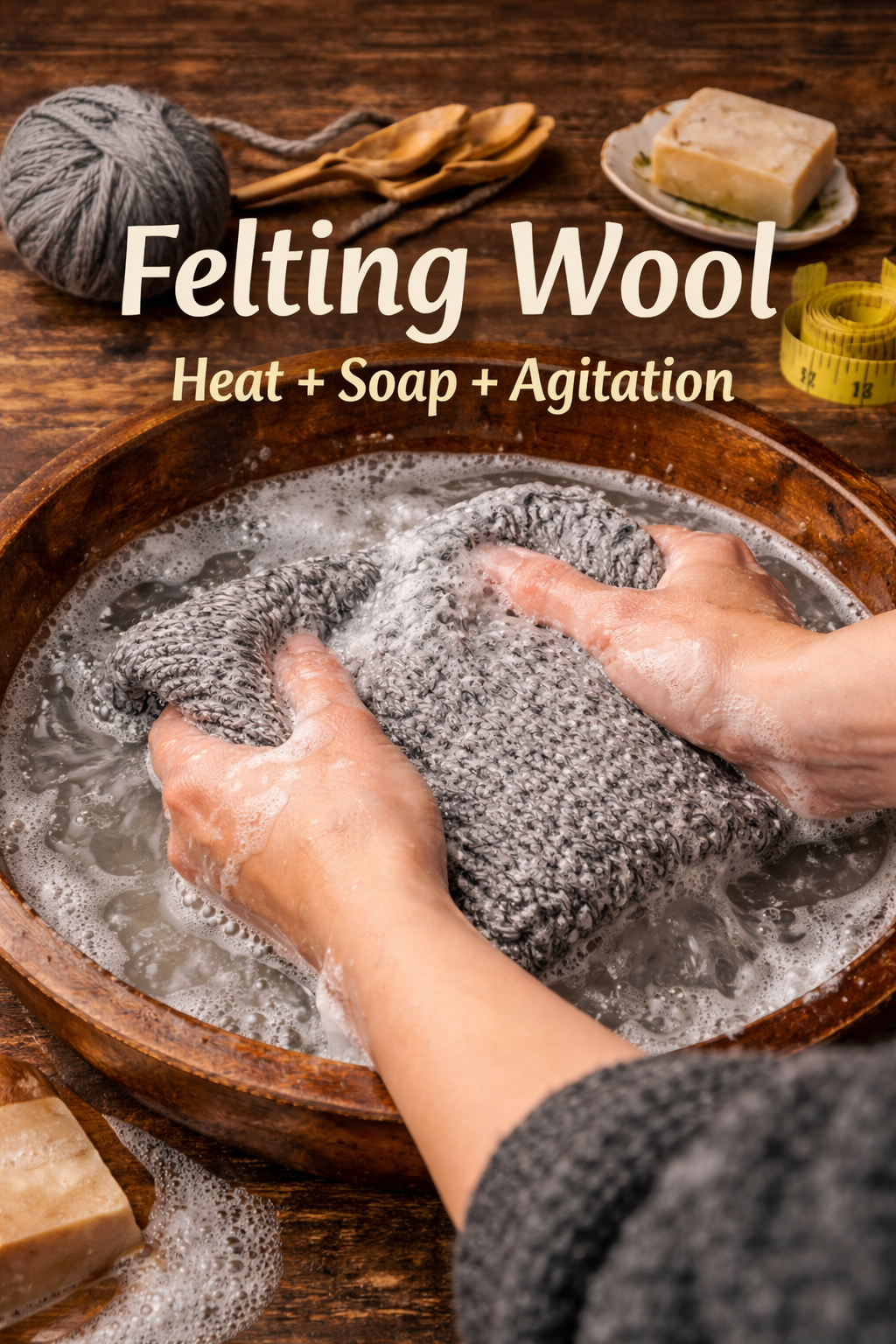
How it works
Felting wool requires 100% Wool or an animal fiber like alpaca. The wool fibers are covered in tiny scales.
When the scales are exposed to hot water, they loosen and become pliable. Add a little soap and agitation, and those scales become tangled (felted) together. Thus, permanently locking the fabric into a dense mat.
You can control the amount of felting by controlling the agitation.
The final step is called FULLING. That sets the felted fibers and evens out the final product.
1. Heat
Hot water opens the scales on the wool fibers. The hotter the water, the faster felting begins.
2. Moisture + Soap
Water allows fibers to move; soap reduces surface tension so the fibers can slide and tangle more easily.
3. Agitation
Movement causes the open scales to catch and lock together. This can be rubbing, squeezing, tumbling, or friction.
More of any one factor increases shrinkage—but agitation is the real accelerator.
Hand Felting v. Machine Felting
While hand felting offers a great deal of control, you can also felt a knit item by using a washing machine and tumble dryer.
The important thing to note is the maximum amount of shrinkage you can expect from your wool yarn.
When you hand-felt, you control the amount of “shock” to the fiber. You monitor it in real time and can decide when you are done.
In machine felting, it is best to assume that maximum shrinkage will be achieved.
Calculating the shrink rate
- Create a Swatch
- Knit a 10×10 swatch using the yarn and needles you will use in your project.
- Wash and Dry
- Use the same methods that you intend to use on the final product.
- Measure
- Determine the difference in size of the final felted swatch.
- Math
- Shrinkage % = (Original size – Felted size) ÷ Original size
If you would like a step-by-step guide to knitting a felted slipper, you may be interested in this great workshop!
Knit Bigger
Since we know that our final knit project is going to be smaller, we need to knit bigger!
But HOW MUCH BIGGER is the question.
That is easy to determine once we know the shrink rate. (See steps above).
Calculating the Knitting Size
Determine the desired finished measurement.
Subtract the shrink rate from 1
Divide by the final desired size
Ex. If your finished slipper needs to be 10″ long and your shrinkage rate is 25%:
10 ÷ (1 − 0.25) = 13.3″.
Putting it all Together
Now that you know how felting works and how to calculate the shrink rate into your pattern, you are ready to get your FELT ON!

Knit Slippers Workshop
Knit Slipper Video Workshop
Ready to knit slippers that actually fit and feel amazing?
In this beginner-friendly video workshop, you’ll create a pair of soft, sturdy knit slippers while learning two essential new skills you can use in tons of future projects.
You’ll master:
• A simple, versatile cast-on method for clean, stretchy starts
• The 3-needle bind off for a strong, professional finish
Best part? These slippers are:
✔ Easy and relaxing to knit
✔ Customizable to fit any foot (kids to grown-ups!)
✔ Perfect for gifting, lounging, or showing off your handmade magic
What You’ll Learn
-
Step-by-step slipper construction (no guesswork)
-
How to adjust sizing for a perfect fit
-
Two foundational knitting techniques you’ll use again and again


